
Practice-based professional education
Training
Professional Deep Emotional Work training for clinicians, institutions, and social-sector teams. Training is the input; demonstrated capability is the standard.
For institutional MHPSS teams, see how training connects to Method, Person and Programme assurance.
Silent documentary footage from a DEWA professional training workshop. Playback remains muted.
Training in practice
Selected teaching contexts
These images document teaching and workshop settings. They are not endorsements, certification claims, clinical approvals, or outcome claims.

Karad, India, December 2023
Two professional workshops with psychiatrists at KVV / Krishna Institute of Medical Sciences in Karad.


Professional training in the Deep Emotional Work framework.
DEWA training helps qualified practitioners and institutions build practical capacity for stabilization, resource-oriented work, emotional processing, and responsible implementation.
It is advanced work, taught with clear prerequisites, role boundaries, supervision, and professional responsibility. Established technique families are integrated into a teachable framework, not presented as a substitute for licensure or clinical governance.
Stabilization first. Processing only when readiness, role, and supervision are clear.

What Training Develops
- Stabilization capacity. Grounding, regulation, resource-oriented inner work, guided imagery, breathing techniques, and pacing.
- Method architecture. How DEW integrates established technique families into a coherent training sequence.
- Processing readiness. When deeper emotional processing may be appropriate, and when it is not.
- Professional responsibility. Consent, containment, referral boundaries, documentation where appropriate, cultural fit, and institutional scope.
Who Training Is For
Training can be relevant for clinicians, psychologists, counselors, social-sector professionals, humanitarian practitioners, educators, coaches, body-oriented practitioners, and institutional teams working with emotional stabilization or trauma-informed support.
The depth of each format depends on professional background, setting, local regulation, and available supervision. Attendance does not authorize clinical work, replace licensure, or certify independent competence.
Training Pathway
- Foundations and self-experience. Resource awareness, stabilization, inner-state observation, boundaries, pacing, and the distinction between supportive emotional work and clinical treatment.
- Stabilization and resource work. Practical methods for grounding, regulation, resource-oriented inner work, guided affective imagery, breathing techniques, and structured support.
- Emotional processing principles. For prepared professional audiences, the logic of deeper emotional processing with stronger prerequisites, tighter boundaries, and supervision.
- Integration and responsibility. Consent, containment, timing, escalation routes, documentation where appropriate, referral boundaries, and institutional fit.
- Supervised practice and portfolio. Where a practitioner pathway is relevant, supervised practice, documentation, portfolio review, and assessment remain separate from attendance.
DEWA apprenticeship
For established professionals ready to move beyond method instruction, the DEWA apprenticeship provides a supervised pathway for refining judgement, deepening application, and advancing toward mastery. Join the interest list to describe your professional context and be considered when a suitable training place and supervision arrangement becomes available.
Registering interest is the first step in the entry process. It does not reserve a seat or establish admission, certification, or DEW Apprentice status.
Formats
- professional seminars and foundation workshops;
- institutional training days for hospitals, universities, NGOs, municipalities, or social-sector teams;
- cohort-based programs with supervised practice cycles;
- customized development packages for institutions and professional teams.
Introductory formats emphasize stabilization, resource work, and professional orientation. Advanced formats can address complex psychological trauma, emotional processing, and professional integration with stricter selection and supervision.
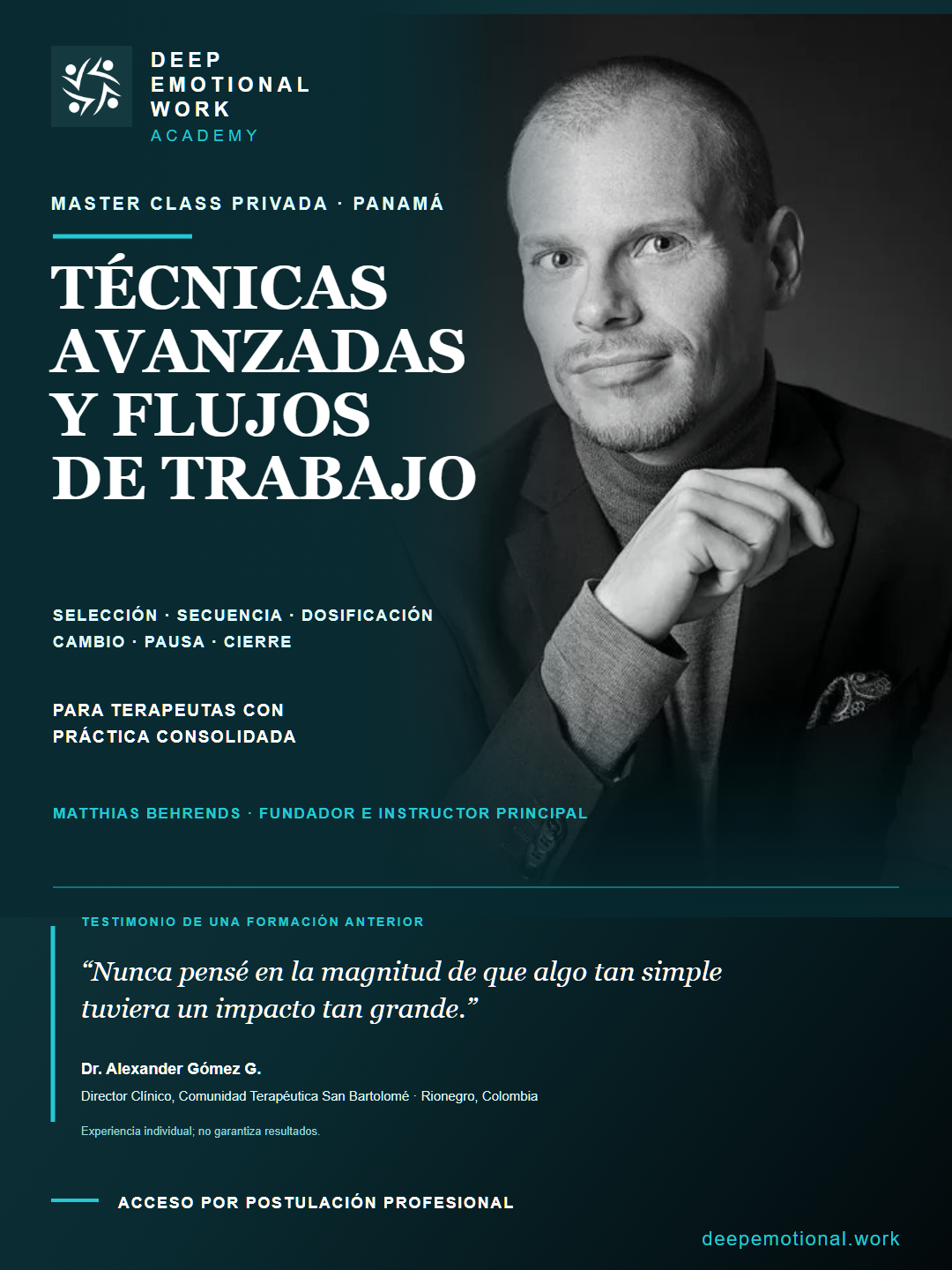
Panamá: Master Class privada para terapeutas con práctica consolidada
La experiencia es el punto de partida.
La Deep Emotional Work Academy (DEWA) ha desarrollado un formato privado para profesionales que ya conocen múltiples técnicas y quieren examinar con mayor precisión las decisiones que conectan una intervención con la siguiente: selección, combinación, secuencia, dosificación, monitoreo, cambio, pausa y cierre.
El núcleo es una demostración comentada con un escenario completamente ficticio. Los participantes observan el flujo de trabajo, contrastan una ruta alternativa y analizan las decisiones entre pares. Nadie presenta casos, demuestra competencia ante el grupo ni tiene que abandonar su propia modalidad.
Lo que ofrece el formato
- Acceso por postulación profesional para un grupo de ocho a diez participantes.
- Observación directa de técnicas avanzadas dentro de un flujo de trabajo visible.
- Análisis de las decisiones, alternativas, límites y puntos de cierre.
- Una guía de observación y un mapa de decisiones para continuar la reflexión profesional.
Situación actual
La propuesta está actualmente en evaluación institucional en Panamá. Todavía no se han anunciado institución anfitriona, fecha, sede ni convocatoria pública. Una fecha solo puede confirmarse cuando una institución cualificada asuma la organización y la gobernanza profesional local, y se haya resuelto por escrito la clasificación aplicable a la actividad.
¿Su institución debería evaluar este formato?
Escriba a contact@deepemotional.work con el nombre de la organización y la función responsable de formación o actividades académicas.
Selected Training And Institutional References
These examples document settings where Matthias Behrends has taught, presented, supported, or delivered DEW-related emotional-stabilization and capacity-building work. They are historical references, not current partnerships, endorsements, certification claims, or clinical approvals.
Training, Workshop, Or Teaching Contexts Led By Matthias Behrends
- City of Mannheim, Germany
- City of Mullheim, Germany
- District Office Hohenlohekreis, Germany
- Evangelical Church Kassel administration, Germany
- Netzwerk Chancen gestalten, Germany
- Mosaik Deutschland e.V., Germany
- KIRON Berlin, Germany
- Ankommer.eu Frankfurt, Germany
- University of Erlangen Institute for Medical Ethics, Germany
- Krishna Institute of Medical Sciences, Department of Psychiatry, Karad, India
- Technological University of Bolivar, Cartagena, Colombia
- Chambacu Foundation, Cartagena, Colombia
- San Bartolome Comunidad Terapeutica, Colombia
- Universidad Ricardo Palma, Lima, Peru
- Moscow University, Russia
Related Contexts With Specific Role Boundaries
- Diakonisches Werk Schwabisch-Hall, Germany: accompanied multi-day trauma trainings led by Dr. med. Charlotte Baltrusch (ret.).
- Arad, Romania: organized and assisted a seminar with Dr. Baltrusch for social workers and orphanage staff.
- German Consulate General and Hospital de Mar, Barcelona: psychological first aid after the 2017 mass-casualty event.
- Nepal Red Cross Society: online consultation after the 2015 earthquake.
- Bangladeshi hospital and institutional staff: selected pro bono supervision and Bengali resource access.
Framework Resource For Clinicians
For clinicians and professional audiences evaluating the deeper method framework, DEWA maintains a concise overview of its approach to complex psychological trauma. It is a framework map, not a standalone treatment manual.
Scope And Boundaries
DEWA provides professional education, methodology, supervision, and implementation support. It does not provide emergency services, medical care, psychotherapy, diagnosis, or crisis intervention through this website. Clinical or regulated use remains the responsibility of qualified professionals and institutions. Matthias Behrends is not a licensed therapist or psychologist.
Discuss A Training Format
For individual, cohort, university, hospital, NGO, or social-sector training, contact the Academy with your role, organization, country, participant group, and the level of work you are considering.
Contact: contact@deepemotional.work