
Creative Commons implementation kit
Deep Emotional Stabilization Groups
In crisis, conflict, and post-conflict settings, complex psychological trauma is the norm rather than the exception for vulnerable populations. The kit supports the first stabilization layer: helping people become better prepared for the deeper complex-trauma work they are likely to need.
Videos
Implementation guide videos
-
Deep Emotional Stabilization Groups: Guiding a Session, Part 1
-

Deep Emotional Stabilization Groups: Guiding a Session, Part 2
Clicking “Play video” loads the video from YouTube (Google). Google then receives your IP address, may store cookies and may process data in the USA. By clicking, you consent to this. Your choice is saved in the , where you can withdraw it at any time. Privacy details
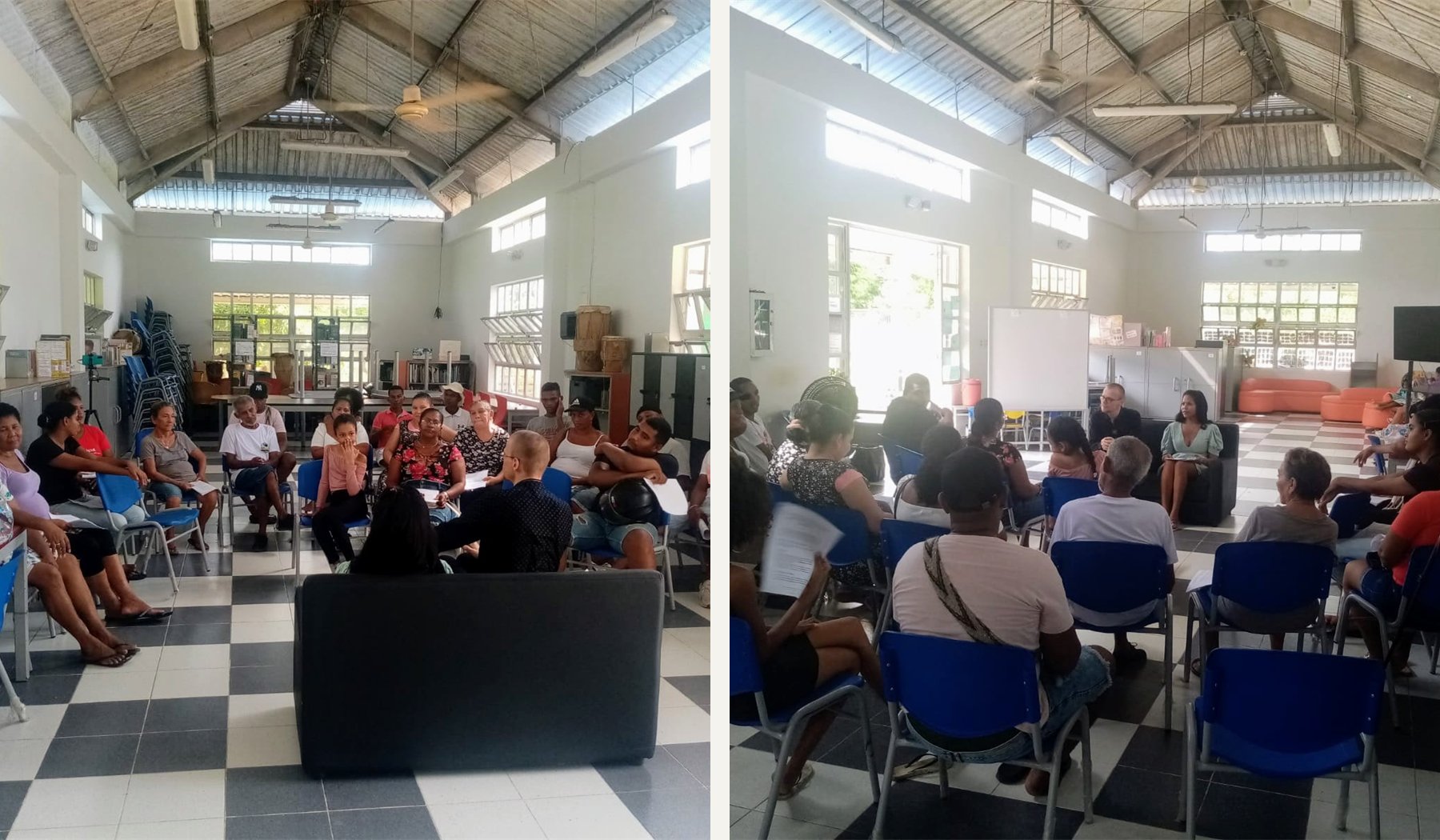
Real setting
Built for the layer before deeper trauma work.
Read Stabilization Groups in Context: The Missing Link Between First Aid and Specialist Care.
The kit grew from practical group work and guide training. It keeps that reality visible while giving local teams a clear structure for early stabilization, local preparation, and responsible support routes.
Why this layer matters
Where complex trauma is the norm, stabilization has to scale
Technique, not just structure
The value sits in the refined Guided Affective Imagery and step-by-step stabilization sequences: wording, pacing, transitions, worksheets, and closure.
Designed to scale the first layer
When specialist care cannot be first contact for everyone, trained local teams need a repeatable stabilization format that keeps support routes open.
Language makes scale possible
Translations and language packs let teams review the technique in their own language before local adaptation.
Application scenarios
Where this format is useful
Deep Emotional Stabilization Groups are not only for people already in visible distress. They are useful wherever people need a shared, repeatable stabilization routine before deeper work becomes realistic.
Crisis or post-crisis settings
For people affected by conflict, displacement, chronic insecurity, loss, violence, or prolonged stress, the groups offer structured practice in grounding, inner orientation, guided imagery, pacing, and closure.
Staff and local helpers
The same routines should be available to the people who support others. Facilitators, educators, volunteers, interpreters, and community workers can practice the method from the inside before guiding it for others.
Before deeper trauma work
Where complex trauma is common, stabilization groups can create the first layer: more orientation, a reliable practice routine, and better preparation for referral, follow-up, or deeper complex-trauma work.
Mixed or separate groups
Groups can be mixed when the setting is safe and roles are clear. They should be separated when power dynamics, confidentiality, staff roles, safeguarding concerns, or local culture make a mixed group unsuitable.
Aggregate field observation
28%
reduction in immediate self-reported stress
- Participants
- n = 17
- Internal analysis
- p = 0.0098
Aggregate result only. Identifying context is intentionally omitted.
Internal field evaluation
An immediate change in a real training setting
An internal, non-peer-reviewed before-and-after field evaluation involved 17 seminar participants in a 90-minute introductory seminar. Selected stabilization exercises accounted for no more than about 30 minutes. The aggregate comparison showed a 28% reduction in immediate self-reported stress.
This field observation sits alongside, and does not replace, the existing evidence for the techniques used. It was not an evaluation of the current full DESG workflow.
Methods
Internal before-and-after self-report; 17 seminar participants; 90-minute introductory seminar; selected stabilization exercises no more than about 30 minutes; immediate endpoint; p = 0.0098.
How to read it
Small sample, self-reported outcome, immediate time point, and no peer review. The result does not establish causation or predict what the current full DESG workflow would produce.
Evaluation is continuing. Further methods and aggregate findings will be added here as complete, reviewable datasets become available.
Implementation path
Scale the first layer responsibly
-
Kit
Work from the implementation kit
Use the current kit as the source for technique wording, session pacing, worksheets, and boundaries.
-
Team
Prepare people who can hold the first layer
Name local leads, support route, and supervision or referral path before inviting participants.
-
Scale
Scale only inside clear limits
Run groups as stabilization and preparation, with pathways open for follow-up and deeper complex-trauma work.
Implementation listing
Practitioners using the kit can ask to be listed.
If you are preparing or running Deep Emotional Stabilization Groups with local responsibility, tell us where and how the kit is being used. This can become the basis for a public implementation listing and, later, a map of where the format is being put into practice.
A listing is not certification, clinical approval, or endorsement. It records responsible local use after basic context review.
Implementation assistance
Free kit. Real implementation support.
The PDF is free for noncommercial use under CC BY-NC-SA 4.0. Funding does not buy access to the kit. It supports the work around it: preparing the people leading groups, reviewing language, setting up supervision, and learning from responsible local use.
-
01
Prepare the people leading groups
Training and supervision for those who will hold the session locally.
-
02
Adapt the setting
Language, consent, privacy, safeguarding, and referral routes.
-
03
Keep the kit alive
Maintenance and field learning from anonymized, responsible use.
Public updates
Occasional notes on kit updates, language review, and implementation support.
Language review
Help make the kit clear in your language
The English kit is the reference. If you know one of the language versions deeply, help us catch awkward wording, cultural mismatches, and safety-relevant misunderstandings before the text reaches participants.
- EnglishControlling reference
- ArabicReview in progress
- BengaliDraft exists; needs refinement
- Chinese / MandarinDraft exists; needs refinement
- FrenchDraft exists; needs refinement
- GermanReview underway
- Hindi, MarathiReview in progress
- IndonesianDraft exists; needs refinement
- NepaliDraft exists; needs refinement
- Persian / DariDraft exists; needs refinement
- PolishDraft exists; needs refinement
- PortugueseDraft exists; needs refinement
- RussianDraft exists; needs refinement
- SpanishReview underway
- SwahiliDraft exists; needs refinement
- TurkishDraft exists; needs refinement
- UkrainianDraft exists; needs refinement
- UrduDraft exists; needs refinement
- VietnameseDraft exists; needs refinement
Implementation reference
For teams preparing rollout
The sections below keep the implementation notes, language status, and responsible-use boundaries in one place for teams preparing local use.
The Deep Emotional Stabilization Groups - Implementation Kit is the canonical source for this format. This page gives the public orientation: what the format is for, what responsible implementation requires, how the Creative Commons release is bounded, and where to seek supervision, funded access, or licensing support.
Implementation Kit
The kit is a maintained practical publication for people and organizations who want a careful, low-infrastructure way to organize emotional stabilization groups. It organizes the format around clear local responsibility, consent, safety, privacy, safeguarding, review, and referral obligations.
The intended public license is Creative Commons Attribution-NonCommercial-ShareAlike 4.0 International (CC BY-NC-SA 4.0). Commercial use requires separate written permission.
The implementation kit is permanently archived on Zenodo with DOI 10.5281/zenodo.21216870. The DOI always resolves to the latest version.
What The Kit Provides
The implementation kit brings selected resource-oriented exercises into a guided group structure with preparation, voluntary participation, informed consent before the session, scripted guide language, safety and stop reminders, printable participant worksheets, local adaptation guidance, and optional anonymous local evaluation.
It is intentionally practical. It gives responsible local implementers a starting point for group setup, participant information, consent workflow, safety and referral planning, guide wording, session structure, room setup, public invitation wording, and local review.
Responsible Use
The shortest responsible path is:
- Read the full implementation kit before planning a group.
- Confirm that the intended participant group is suitable for a non-clinical group format.
- Name the locally responsible person or organization.
- Review local legal, privacy, safeguarding, professional, and institutional obligations.
- Prepare the safety and referral path before inviting participants.
- Use the current session protocol without improvising the core structure.
- Make participation voluntary and consent-based.
- Do not require participants to share painful personal experiences.
- Keep emotional-resource notes with participants; do not collect them.
- Use anonymous self-evaluation only as an optional local learning format unless a separate legally reviewed arrangement exists.
- Use supervision or consultation for first implementations, adaptations, difficult contexts, and quality assurance.
Boundary
Deep Emotional Stabilization Groups are structured group sessions for practicing guided emotional stabilization exercises. They are non-clinical professional education by default.
They are not psychotherapy, medical care, diagnosis, treatment, crisis intervention, trauma processing groups, clinical research, a substitute for professional mental health care, a guaranteed outcome method, a certification pathway by themselves, or authorization to represent DEWA.
Local Review And Readiness
Local review is required before use in institutions, clinical settings, vulnerable populations, minors protocols, paid or commercial settings, repeated local programs, non-English participant-facing materials, or any implementation that collects, stores, or shares evaluation data beyond anonymous local worksheets.
Reading the kit is not the same as being ready to guide a group. Early implementations should stay close to the scripts, use suitable supervision or consultation where needed, and begin with a participant group, room, staffing level, and support route that the local team can responsibly hold.
The kit asks local teams to prepare a local implementation brief before public invitation or registration. That brief should name the host or responsible organization, facilitator, participant group, consent workflow, safety route, room setup, language version, evaluation workflow, review status, and supervision or post-session review route.
Consent, Worksheets, And Evaluation
Participants should receive participant information and consent materials before registration or sign-up, not for the first time in the group room. If written consent is required, it should be handled through a private pre-session process rather than a group-pressure moment.
The My Emotional Resources worksheet is for private participant notes and should not be collected by the facilitator or host. If evaluation is used, the Self-Assessment And Session Impact worksheet is a separate optional anonymous local evaluation form.
Completed evaluation forms should stay with the local responsible team unless a separate reviewed local process has been explained before participation. DEWA should not receive names, contact details, diagnoses, signatures, personal stories, medical records, therapy records, crisis details, or identifiable participant records.
Supervision, Funded Access, And Licensing
DEWA recommends supervision or consultation for first implementations, institutional rollout, humanitarian or post-conflict settings, work with vulnerable groups, commercial use, and adaptations to new languages or local contexts.
Commercial licensing does not automatically grant DEWA certification, endorsement, trademark use, supervision, method-fidelity approval, or authorization to represent DEWA. Those require separate written approval.
For supervision, training, implementation consultation, funded access, partnership discussion, translation review, implementation learning, or commercial licensing, contact contact@deepemotional.work.