Could guided affective imagery support emotional access in eating-disorder care?
Eating disorders can make emotions difficult to notice, distinguish, tolerate or understand. This paper asks whether participant-controlled guided imagery could help make meaningful emotion more accessible before any movement begins.
Read the preprint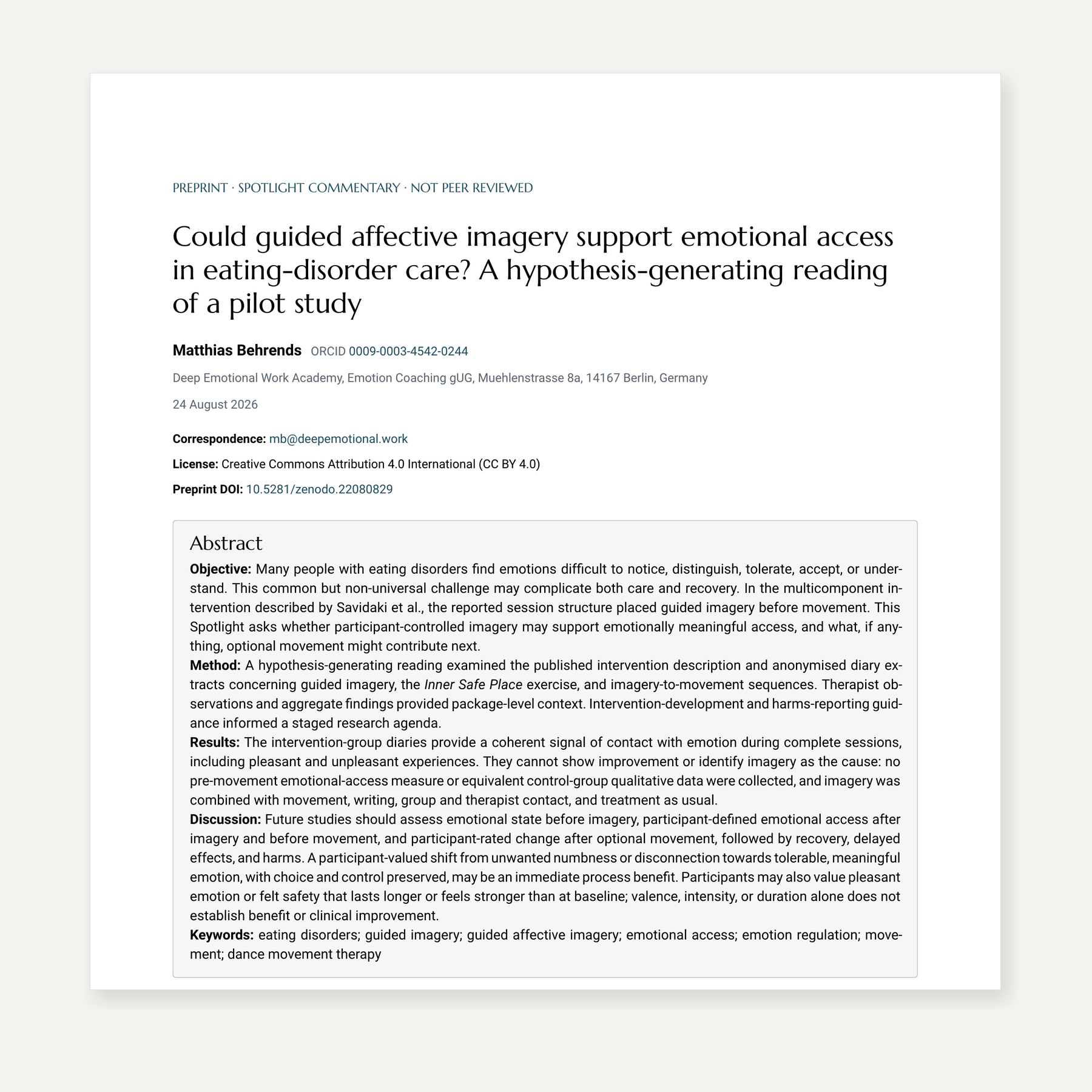
What makes the question worth testing
There is a missing measurement point
The diaries were written after complete sessions. They cannot tell us whether imagery, movement or another part of the session mattered. The crucial next measurement is after imagery and before movement.
Emotional access does not have to feel pleasant
A participant may value moving from unwanted numbness or disconnection towards an emotion that is tolerable and meaningful, even when it is unpleasant. That is an immediate process question, not a claim of clinical improvement.
Movement is the next question, not the answer
Movement remains optional. Measure emotional access first, then ask what, if anything, movement changes.
Participant control belongs in the study design
Choice, control, freedom to pause or stop, recovery, delayed worsening and harms all need to be measured.
Interested in testing this sequence?
We welcome conversations with researchers and institutions interested in eating disorders, guided imagery, emotional access, the role of optional movement, feasibility or safety.
Reach out to contact@deepemotional.work